|
|
When approaching an acoustical problem and considering treatment it is important to understand a few basic things. The difference between blocking and absorbing, what products do what job and where each product needs to be installed.
Blocking (Treating a sound transmission problem / soundproofing):
Increasing the mass between space A and Space B
Eliminating hard surface contact from space A to space B (room within a room).
Eliminating any common air spaces the room has with adjacent spaces. (HVAC, doors, windows)
Viscoelastic dampers (Green Glue, Quiet Rock, etc.)
This problem NEEDS to be addressed during the construction or planning for the project - it is much more difficult to try to fix after the structure is put together and finished. If you think about the sound as "water" in this case, it is fairly easy to visualize. If you fill a room with water, how will it likely get out of that room? (Under and around the doors) (out of the HVAC system) (any other outlets and penetrations) That is where you need to start.
A 1% air gap in any kind of sound barrier will leak 30% of the sound
A 5% air gap in any kind of a sound barrier will leak 90% of the sound
A de-coupled wall assembly will perform better than ANY coupled wall assembly.
|
|
If wall thickness is a concern, consider adding mass to the wall.

Insulation does not block sound!!!!! It is an extremely common misconception that stuffing some fiberglass into a wall will make that a soundproof wall assembly. Insulation is mostly air, which is why it is a good thermal barrier. Sound travels through air – so sound will travel through any soft, light, fluffy insulation. It is a good idea to get the insulation into the wall while it is being built because it is cheap and it will help. Think about the inside of the wall as a very small room. It is a room made of all hard surfaces that will reflect sound. The insulation inside the wall will absorb the echo (standing wave) within the wall which will help the entire assembly.
Absorption (Treating an echo problem):
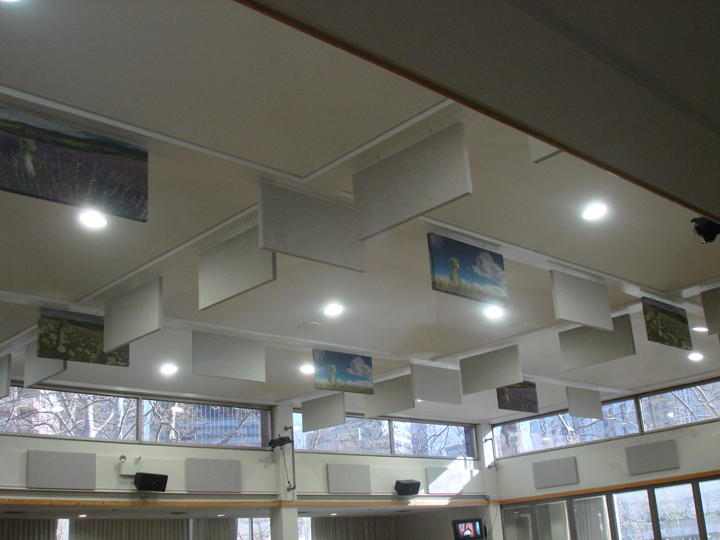
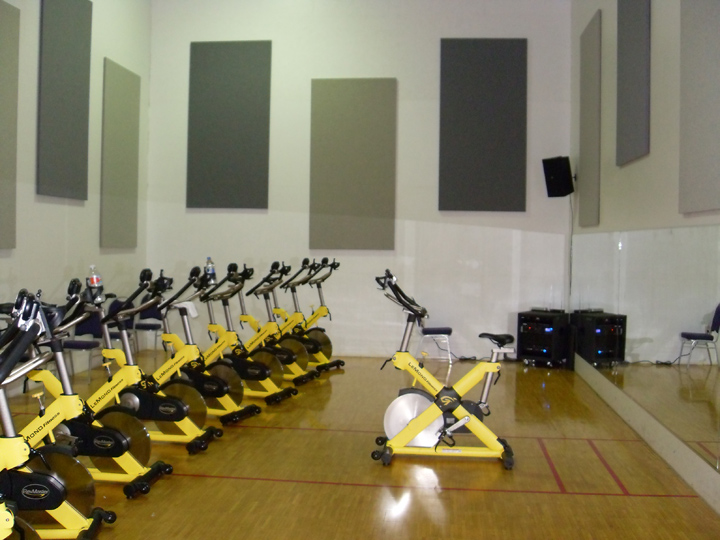
This is done with finished wall surfaces like wall panels, ceiling panels, baffles, drop ceilings, or soft thick floor coverings like carpet with a thick pad. The softer the surfaces in the room the less echo one will experience. Absorbing echo and reducing reverberation is a much easier task than blocking sound transmission but there are quite a few options regarding specifics.
The amount of absorption that a room will need is directly relative to what the room is used for
School Cafeteria - low square foot of absorption
Classroom - medium amount of absorption
Recording studio - High amount of absorption
QUANTITY
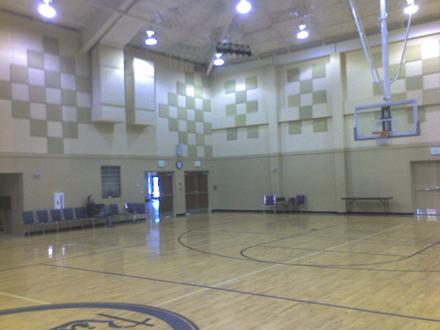
The answer to this question is going to be up to you (relative to how the room is used.) I have some simple guide lines that one can use to get started, but different restaurants are going to have different needs. You very well might need to get some panels into the space and assess the situation. It may be enough, and you may need to add more - the exact number might take some time to figure out based on your needs and expectations for the space. Now that I've explained my disclaimer, here is the equation that I use to get the ball rolling in terms of quantity. I take the cubic volume of the room and multiply it by 3% for a smaller room, and 4% for a larger room. The room that I noted above, I would consider a larger room, so I would multiply the height, width, and depth of the room to determine the cubic volume of the room. I would then multiply that number by 4% (.04) which would be the approximate square footage needed for that room.
Example Room: 30' wide x 40' deep x 12' tall = 14,440 cubic feet of volume
14,440 x .03 (3%) = 433.2
A room of this size needs approximately 440 square feet of paneling (55 2'x4' panels)
LOCATION
As wall or ceiling panels are installed into the space, it will inevitably affect the aesthetic of the room - they will be seen. The exact location is more of an aesthetic call rather than a "the panels have to be here in order for them to work" call. Typically, for most generic "take the edge off" rooms, the panels can really be placed anywhere in the room and have the same result.
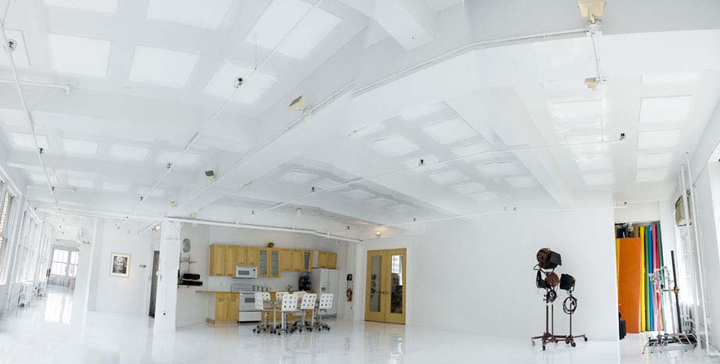
The studio pictured below is a prime example of an extremely reflective room - painted concrete. The guy that owns the photo studio was a very excitable New York native with a strong east cost accent. After the panels arrived on site, he flipped on a portable CD player and bean to open the boxes. He set the panels on the floor with the intent of spacing them out to create a balanced spacing. After all the panels were on the floor, he began moving his ladder around and gluing each one to the ceiling. After he got the panels into the room and completed the installation, he called me and was VERY excited. He reported that weather all of the panels were on the floor, half floor - half ceiling or all of the panels were on the ceiling it sounded exactly the same in the room.
There are a few tricks of the trade and the "put them where ever you want" approach is definitely not the answer to the location question all of the time, in most cases it will make the end user comfortable in the room assuming that the correct square footage is used.
THICKNESS
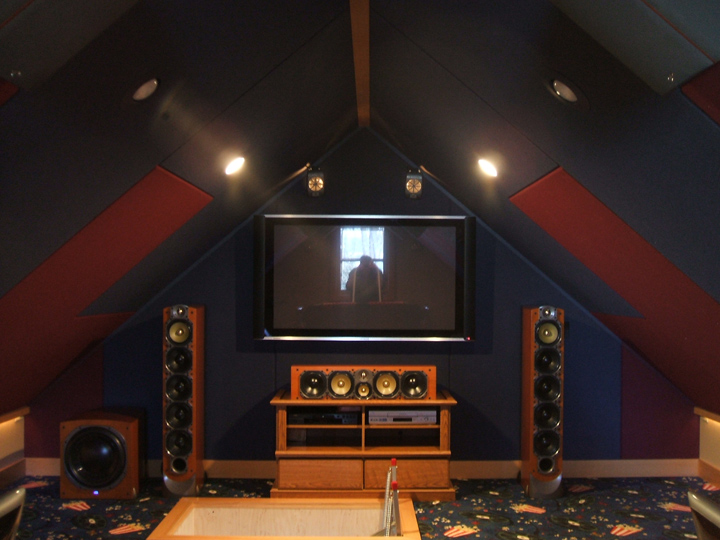
The thickness of the panels is usually called out by the architect, designer or the customer. The basic thing to keep in mind is the increase in low frequency absorption with increasing panel thickness. If a one-inch acoustical panel has an NRC of .80 and the room in question was a school cafeteria, there would be absolutely no need to use a 2" thick panel in that case. If the room in question were a high end recording studio or a home theater, the 1" thick panel would not provide enough low frequency absorption in certain areas to give the end user the desired result.
The two most important factors here are the use of the room and the absorption coefficients of the panels in question.
|
|
|
|