|
|
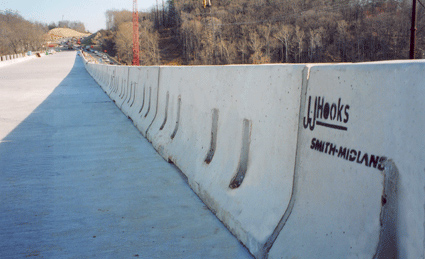
Barriers are product that are only used to block the transmission of sound.
STC Rating:
An STC (Sound Transmission Class) rating is a measure of how much sound is blocked by something. The higher the number the better. STC ratings are calculated by cutting a hole into a wall and "filling" the hole with a different surface. The lab has a speaker on one side of the wall and a microphone on the other. They blast the wall with low, mid and high frequencies and very carefully measure the sound that is blocked by the new surface.
To calculate an STC number, the performance of the 125Hz, 250Hz, 500Hz, 1KHz and 2KHz frequencies are sent at the hole in the wall. The performance is averaged to determine the STC number. The Higher the STC number the better.
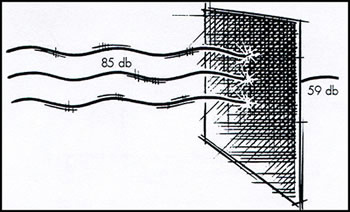
100dBa STC 25 Product 75dBa
**It is VERY important to note that the STC number is a 10 base logarithm!!!
STC: 30 is 100% better than STC: 30
STC: 40 is 100% better than STC: 30
STC: 50 is 100% better than STC: 40
The higher the starting point, the harder it is to get additional STC values
|
|
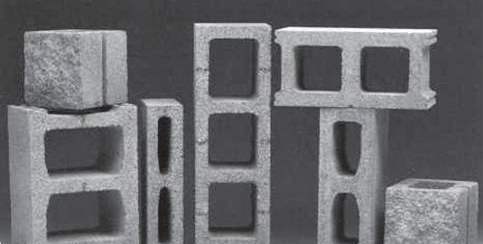
 STC: 26
Adding Mass:
Increasing the amount of mass in a wall or ceiling assembly will reduce the amount of sound that make's its way thru the construction. The more mass the better. This was done in the past by adding layers of lead to the wall assembly. A product called Mass Loaded Vinyl has now been developed to replace lead. It is usually attached directly to the studs with fasteners and sealed to become air tight before the sheetrock is applied.
Doubling the surface mass of a wall assembly will increase the STC rating by 3 points.
Decoupled Wall Assembly:
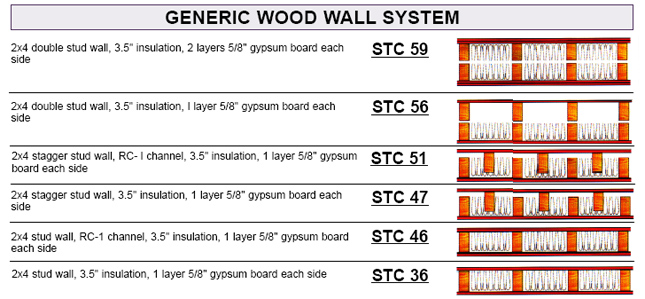
A wall assembly that consists of two separate walls that don't touch each other is a very efficient way to stop sound. Two separate sound barriers separated by an air gap will force the sound energy to transform from a vibration to an airborne sound wave back to a vibration. Each time it changes forms it looses energy.
Common misconceptions:
Insulation does not block sound!!!!! It is an extremely common misconception that stuffing some fiberglass into a wall will make that a soundproof wall assembly. Insulation is mostly air, which is why it is a good thermal barrier. Sound travels through air - so sound will travel through any soft, light, fluffy insulation. It is a good idea to get the insulation into the wall while it is being built because it is cheap and it will help. Think about the inside of the wall as a very small room. It is a room made of all hard surfaces that will reflect sound. The insulation inside the wall will absorb the echo (standing wave) within the wall which will help the entire assembly.
|
|
|
|